

What going gas-free has added up to.
Since 2017, we've run our business on battery power. Here's what that has kept out of Treasure Coast air and neighborhoods, and how we work it out.
Across an estimated 6,000+ visits since August 2017:
These are conservative estimates that grow every week we're out working. They're based on our regular route and leave out gas-free hours on cleanups, hedges, commercial sites, and the yards we've mowed for charity. See how we calculate.
About half as loud, and gone sooner.
Noise is the difference our customers notice first. In a peer-reviewed field study, battery leaf blowers measured about 10 decibels quieter than gas blowers at 50 feet.2 To the human ear, a 10 dB drop sounds about half as loud.
The gap matters most down the street. At 100 to 400 feet, where neighbors hear the work, battery blowers were 4–22 dB quieter. At 800 feet they blended into background noise, while gas blowers could still be heard.2
Leaf blower noise at 50 feet2
The quietest blower in the study was a Stihl battery model at 57 dB(A), the same brand of handheld equipment we use.
What switching your lawn saves.
Pick a schedule and yard size to see what one year of Kick Gas service keeps out of your neighborhood, compared with a crew running gas equipment.
One year of service
Small engines, big footprint, and Florida tops the list.
Lawn equipment engines are small, but they pollute far more per hour than cars do.
1 hour = 1,100 miles
Running a commercial gas leaf blower for one hour produces as much smog-forming pollution as driving a new car about 1,100 miles, roughly Los Angeles to Denver.1
30 million cars' worth
In 2020, gas lawn and garden equipment across the U.S. released over 68,000 tons of nitrogen oxides, comparable to the emissions of about 30 million cars.3
Florida leads the nation
Florida's year-round mowing season puts it at the top of the country for two types of pollution from gas-powered lawn and garden equipment.4
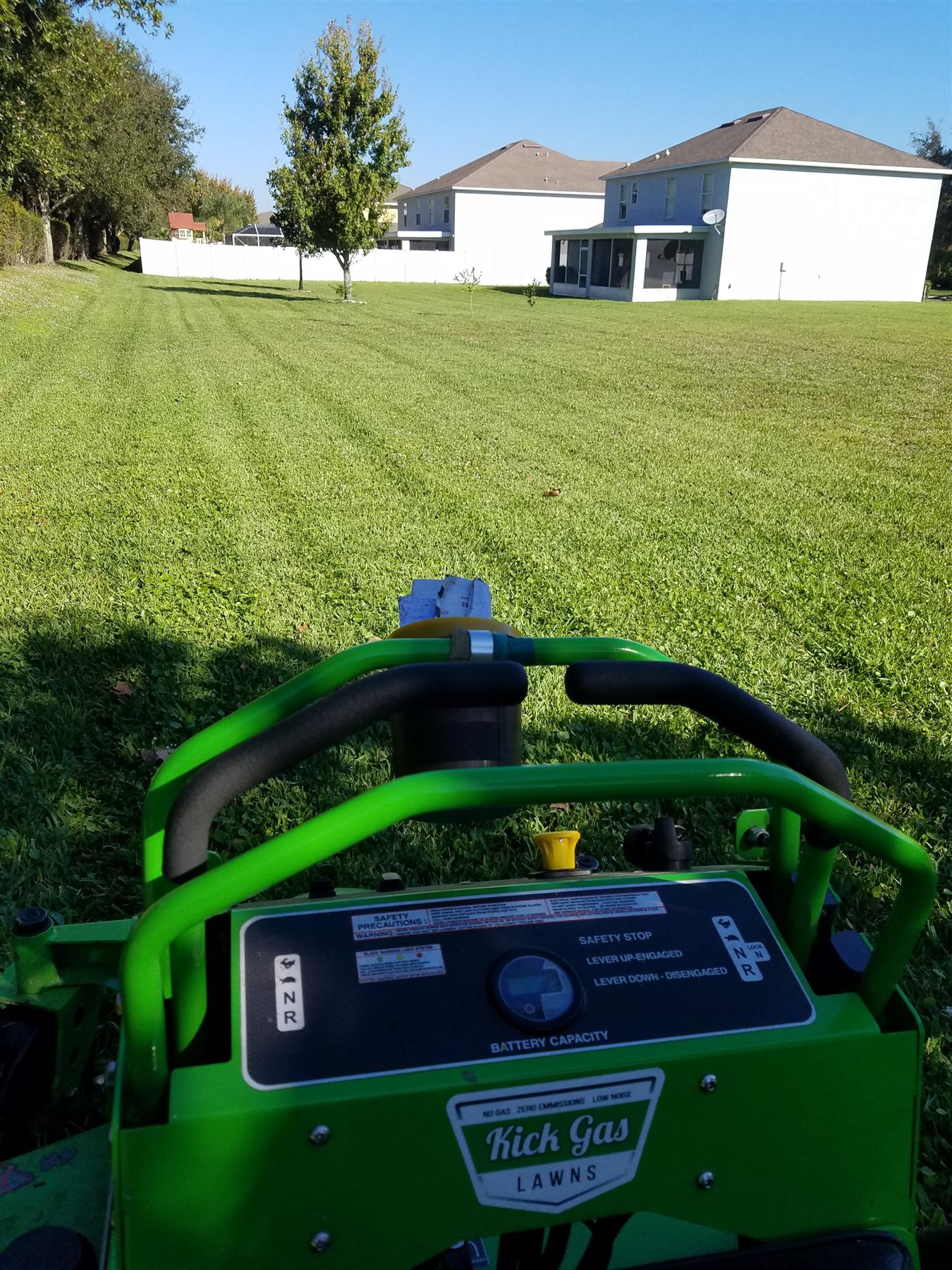
Commercial-grade, battery-powered.
- Mean Green lithium commercial mowers. Rated by the maker at 78–82 dB with blades on high.5
- Stihl battery handheld tools. BGA 100 blowers, FSA 90 trimmers, MSA 200 chainsaw, and AR 3000 backpack batteries.
- No fuel on the trailer. No gas cans, spills, or fumes at your property.
We use battery equipment for nearly every job. On the rare task that still needs a gas engine, we'll tell you up front.
Our math, in plain view.
We'd rather understate our impact than overstate it.
Per visit, a gas crew would burn about 0.37 gallons
- Mower: 0.5 hr × 0.6 gal/hr
- String trimmer: 0.25 hr × 0.1 gal/hr
- Backpack blower: 0.15 hr × 0.25 gal/hr
- Edger: 0.1 hr × 0.1 gal/hr
Run times are conservative averages for a typical residential visit. Fuel rates are typical for commercial gas equipment of each type.
Then we multiply
- Visits: an estimate of our service visits since August 2017, built from our scheduling records and our current pace of about 16 visits a week. It adds up automatically as we keep working.
- CO₂: 19.6 lb per gallon of gasoline burned.6
- Smog: 1,100 car-miles per hour of commercial gas blower use.1
Charging our batteries does use grid electricity. These figures show what gas equipment would have emitted at your property; they aren't a full life-cycle analysis.
Sources
- California Air Resources Board, Small Off-Road Engines fact sheet.
- Pollock, Sparks & Banks, field noise study of gas and battery leaf blowers, Journal of Environmental and Toxicological Studies, 2018.
- U.S. EPA 2020 National Emissions Inventory, as reported by Turf & Rec.
- WUSF, "Florida leads the nation in two kinds of pollution from gas-powered lawn and garden equipment", 2023.
- Mean Green Mowers, manufacturer specifications.
- U.S. EPA, Greenhouse Gas Emissions from a Typical Passenger Vehicle (8,887 g CO₂ per gallon).
Add your yard to the total.
Every new lawn we take on is one less gas engine on your street.